
26 de agosto de 2025
Brazilian AgAv Congress soars in Mato Grosso and sets course for 2026
The 2025 edition ended on Thursday (21) with tributes, authorities and experts talking about the market, trends and challenges, technology showcase, aerial presentations and the announcement of the next edition for Goianápolis/GO, in August next year
Santo Antônio do Leverger/MT — Excitement, celebration, and an announcement marked the close of the 2025 Brazilian Agricultural Aviation Congress (AgAv Congress), held August 19–21 at the Santo Antônio do Leverger Executive Airport, in the heart of Mato Grosso. Over three bustling days, more than 5,000 visitors from 22 Brazilian states and thirteen countries crowded the exhibition halls, attended debates, and looked skyward for the daily aerial demonstrations.
“This year’s Congress once again showed that agricultural aviation is cutting-edge technology in service of sustainable and competitive farming,” said Hoana Almeida Santos, president of the Brazilian Agricultural Aviation Union (SINDAG, in Portuguese acronym). She also revealed where the next edition will take place: Goianápolis, in the Goiás state, from August 18 to 20, 2026.
“We leave Leverger with a sense of mission accomplished,” Hoana added. “Now we go to Goiás, with the challenge of keeping the bar high. It’s a big commitment, but we’ll work all year for it.”
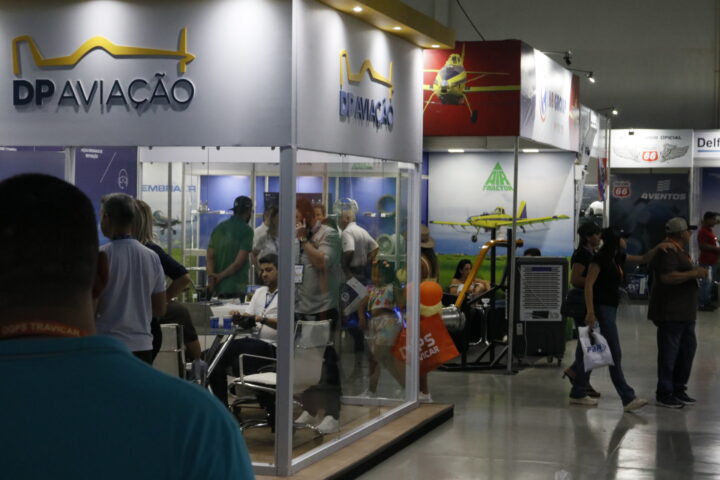
SHOWCASE: more than 200 brands were present at the technology, equipment and services exhibition
Authorities and Global Stage
As in past years, the Congress brought together entrepreneurs, pilots, researchers, engineers, and government officials. Among the dignitaries: Senator Luiz Carlos Heinze (from Rio Grande do Sul State), Mato Grosso’s Lieutenant Governor Otaviano Olavo Pivetta, and the state legislature’s president, Max Russi. Also in attendance was state deputy Marcus Vinícius, who authored a law in Rio Grande do Sul recognizing agricultural aviation as an activity of high social, public, and economic interest.
Representatives from Brazilian federal agencies reinforced the institutional weight of the event, including Uéllen Lisoski Duarte Colatto, head of the Agricultural Aviation Division at the Ministry of Agriculture, and Luiz Ricardo de Souza Nascimento, director of Brazil’s National Civil Aviation Agency (ANAC).
- Click HERE to check out the AvAg Congress photo album…
…and, at the end of the text ↓↓↓, watch the video interviews (in Portuguese)
with the authorities who attended the event
Innovation, Governance, and Growth
The 2025 edition sprawled across 10,000 square meters of space, including a display of aircraft at the airport on the outskirts of Cuiabá. For Sindag’s CEO Gabriel Colle, the event exceeded expectations:
“More than 200 brands were here, filling the technology fair from morning to night, debating operational safety, and presenting innovations,” Colle said. He highlighted not only the presence of ethanol-powered planes, helicopters, and even autonomous aircraft, but also the AgAv Congress’ role in industry sector governance and policy.
The sector’s challenges were addressed in panels led by Sindag’s operations director Cláudio Júnior Oliveira, including the unveiling of the Economic and Sustainability Outlook for Agricultural Aviation 2025. The report underscores Brazil’s status as the world’s second-largest agricultural aviation fleet, with 2,700 aircraft and helicopters that in 2024 treated 136 million hectares (336 million acres) of farmland — generating revenues of 8.17 billion reais ($1.6 billion).
Growth projections point to more than 3,400 aircraft by 2028, serving over 170 million hectares (420 million acres) and surpassing ten billion reais ($ 2 billion) in annual revenues. Added to that, Brazil now counts 8,000 agricultural drones, a fleet expected to expand dramatically in coming years.
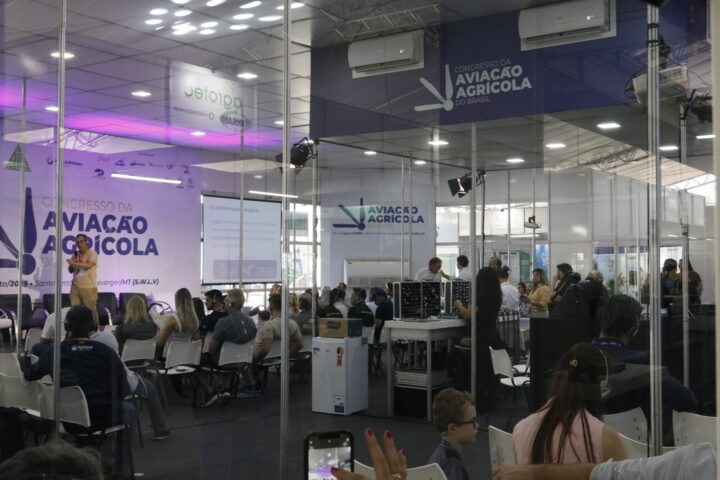
PRESENTATIONS: event that also had numerous lectures and debates on various topics…
Honors and Recognition
The Congress opened on Brazil’s National Agricultural Aviation Day with the awarding of the industry’s highest honor, the Medal of Agricultural Aviation Merit, to three figures:
- Senator Luiz Carlos Heinze, from Rio Grande do Sul State, a long-time defender of the industry in the National Congress.
- Ada Rogato (in memoriam), Brazil’s first female agricultural pilot (1948) and a pioneer recognized worldwide.
- Nelson Antônio Paim, former president of SINDAG, credited with professionalizing the association and reformulating the AgAv Congress starting in 2016.
SINDAG also honored Aeromot, the first company to sponsor the AgAv Scientific Congress, and paid tribute to entrepreneurs and pilots who staged aerial demonstrations — from crop-dusting simulations to firefighting maneuvers and aerobatic shows.

.TECHNOLOGY AND EXPERTISE: aerial presentations showcased the important work aviation does in agriculture
SPOTLIGHT ON SCIENCE
If the exhibition areas were dominated by the murmurings on and gleaming aircraft, the Agricultural Aviation Scientific Congress highlighted the quiet but powerful force of research. More than a dozen universities presented projects tackling sustainability, efficiency, and technological frontiers.
The top award went to the study “Estimated Evaporation in an Aerial Spraying Simulator,” presented by Edney Leandro da Vitória (Federal University of Espírito Santo), alongside Humberto Santiago of the Federal University of Viçosa. The research drew attention for offering new insights into spray drift and evaporation — critical issues for both efficiency and environmental safety.
Second place highlighted the integration of innovative technologies with the environment: “Drones, Biotechnology and Geotechnology in Forest Restoration: An Integrated Approach to Planting and Monitoring Biodegradable Capsules.” Presented by Karine Lopes, with colleagues from the Federal University of Jataí and Goiás’ School of the Future, the project pointed to how aviation tools can accelerate reforestation.
Third place went to a team from São Paulo State University (UNESP/ Botucatu), led by Mariane Tavares Vieira, with a comparative study on “Drone vs. Ground-Based Insecticide Applications in Soybean Crops.” The findings added valuable data to the growing debate on efficiency and precision in pest control.
In addition, the Aeromot Innovation Award recognized another UNESP-led team for its wind-tunnel analysis of droplet spectra from different hydraulic nozzles at high speeds — a study with direct implications for precision agriculture and safety.
Looking Ahead
For SINDAG’s leaders, combining business, politics, and science under one roof is precisely what strengthens agricultural aviation’s role in Brazil’s agribusiness ecosystem.
“With every Congress,” Colle said, “we connect the past, present, and future of agricultural aviation. We’re becoming more professional, more transparent, and showing society that this sector is not only safe — it’s essential.”
The sense of momentum was palpable as the lights dimmed over Mato Grosso’s exhibition halls. The sector now looks toward Goianápolis in 2026, ready to prove once again that Brazil is not just an agricultural powerhouse on the ground — but in the skies as well.
Hoana Almeida – Percepções ao final do evento:
Vice-governador do MT, Otaviano Pivetta:
Senador Luiz Carlos Heinze (PP/RS):
Ex-jogador da Chapecoense e palestrante Neto Zampier:
Gabriel Colle, diretor-executivo do Sindag:
Alexandre Moraes – Condomínio Liberty (local do Congresso AvAg 2026):
Deputado Max Russi (PSB) – presidente da ALMT:
Empresários aeroagrícola e ex-presidente do Sindag Nelson Antônio Paim:
Joelize Friedrichs – Amag:
Deputado Marcus Vinicius – RS:
Hoana Almeida – anúncio do local do Congresso AvAg 2026:
Júlio Augusto Kämpf, presidente do Ibravag:
Moisés Linck, diretor do SNA: